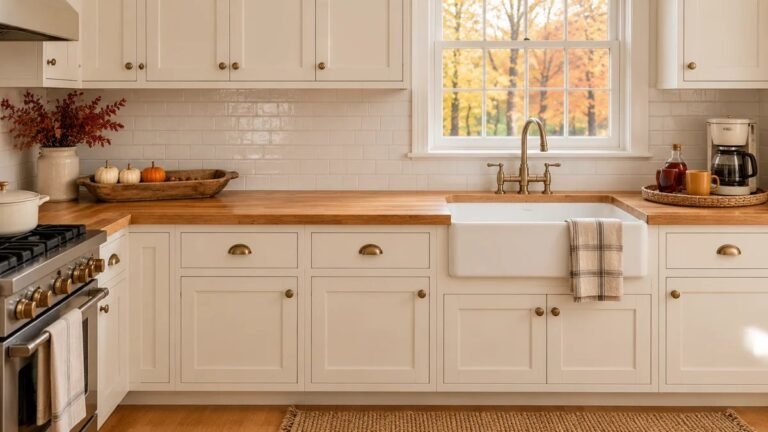
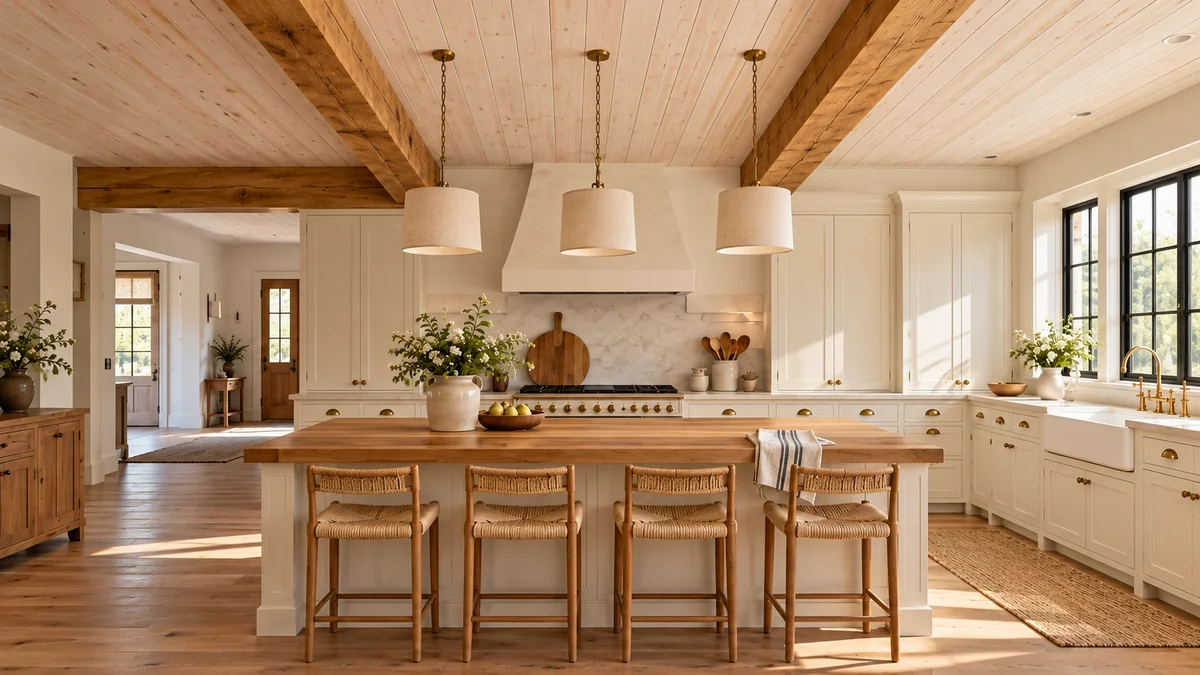
11 Beautiful Wood Ceiling Kitchen Ideas Full of Warmth
These wood ceiling kitchen ideas prove the ceiling is the most overlooked surface in the room. Most kitchens stop at flat white paint overhead, but wood up there adds a kind of warmth you feel the moment you walk in. It works in farmhouses and modern spaces, in big open kitchens and small galley ones, and it does not have to mean a full renovation.
Quick Answer: A wood ceiling makes a kitchen feel warmer and more finished. Start with your budget: faux beams are the cheapest fix, painted or whitewashed planks sit in the middle, and reclaimed wood or custom coffers cost the most. Every one of these wood ceiling kitchen ideas includes a budget note so you can start where you are. Match the wood tone to your floor or cabinets, plan lighting before you start, and make sure your range hood vents well, since grease rises.
How to Choose the Right Wood Ceiling for Your Kitchen
Before you pick a style, sort out three things: tone, budget, and light. These wood ceiling kitchen ideas only look good when the wood tone talks to the rest of the room, so hold stain samples against your cabinets and floor in daylight, not just under store lights.
A few planning notes that save headaches later. Kitchens make steam and grease, so a good range hood matters more once the ceiling is wood; wipeable finishes like satin or matte polyurethane clean far easier than raw wood. Plan lighting before the planks go up, because moving a junction box later means patching wood. And in a kitchen with 8-foot ceilings, keep the wood light and the beams slim so the room does not feel shorter. Get these basics right and any of these wood ceiling kitchen ideas will look intentional rather than improvised.
Wood Ceiling Kitchen Ideas for Every Style and Budget
The wood ceiling kitchen ideas below run from easy weekend fixes to bold designer moves, so start with whatever fits your kitchen today.
Paint It Warm White, Not Stark White
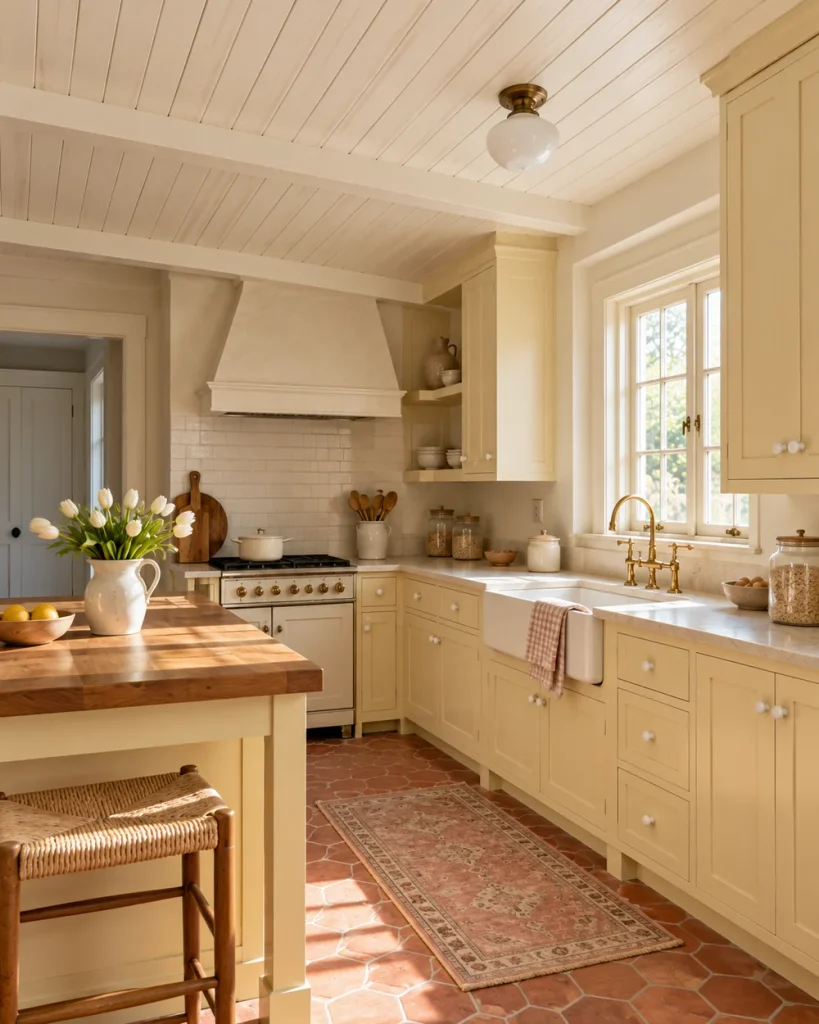
A painted plank ceiling gives you the texture of wood without the heaviness of wood color, and the paint shade decides everything. Stark, blue-white paint flattens the planks and makes them look like plastic. A warm white with a drop of cream or greige in it keeps the shadow lines soft and lets the grain show through faintly, so the ceiling reads as wood that happens to be painted.
This is one of the kindest wood ceiling kitchen ideas for a kitchen that gets little daylight. The planks bounce light around the room, and because the surface is sealed with paint, steam and cooking splatter wipe off with a damp cloth. Use a satin sheen rather than flat; flat paint marks faster over a stove. Run the planks in the same direction as the longest wall to stretch the room visually, and keep beam spacing wide so the pattern stays calm.
Best for: Small or north-facing kitchens that need brightness without losing warmth.
Cozy Tip: Paint a test board and hold it against the ceiling at different times of day. Warm whites shift a lot between morning and lamplight, and the ceiling is the last place you want a surprise undertone.
Try Faux Beams for a Renter-Friendly Fix
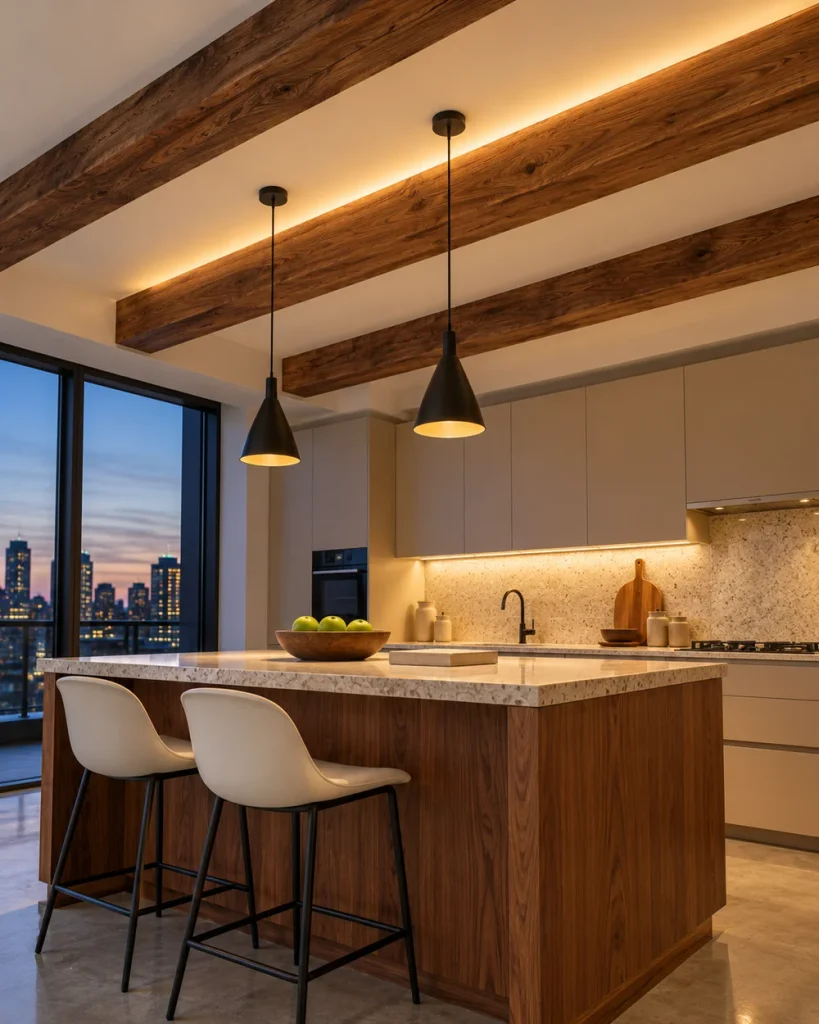
If you cannot touch the structure, hollow polyurethane beams give you the look of real timber at a fraction of the weight and cost. They arrive as three-sided shells that slip over a mounting board screwed into the ceiling, which means no heavy lifting and no contractor in most cases. Good ones are molded from real wood, so the grain and knots fool the eye from a few feet away.
Placement matters more than quantity. Two or three beams running across the narrow direction of the kitchen read as architecture; a beam every two feet reads as a theme. Of all the wood ceiling kitchen ideas here, this is the fastest one to live with. Stain or paint them to sit one step darker than your cabinets so they feel related but not matched. Because they are hollow, you can run a slim LED strip along the top edge for a soft glow that washes the ceiling at night, which is a trick real beams cannot do as easily.
Best for: Renters, condos, and anyone who wants the beam look in a weekend.
Cozy Tip: Order one sample beam first and live with it leaned against the wall for a few days. Color on a screen never matches the real thing, and returns on long beams are a pain.
Cover Only the Island Zone
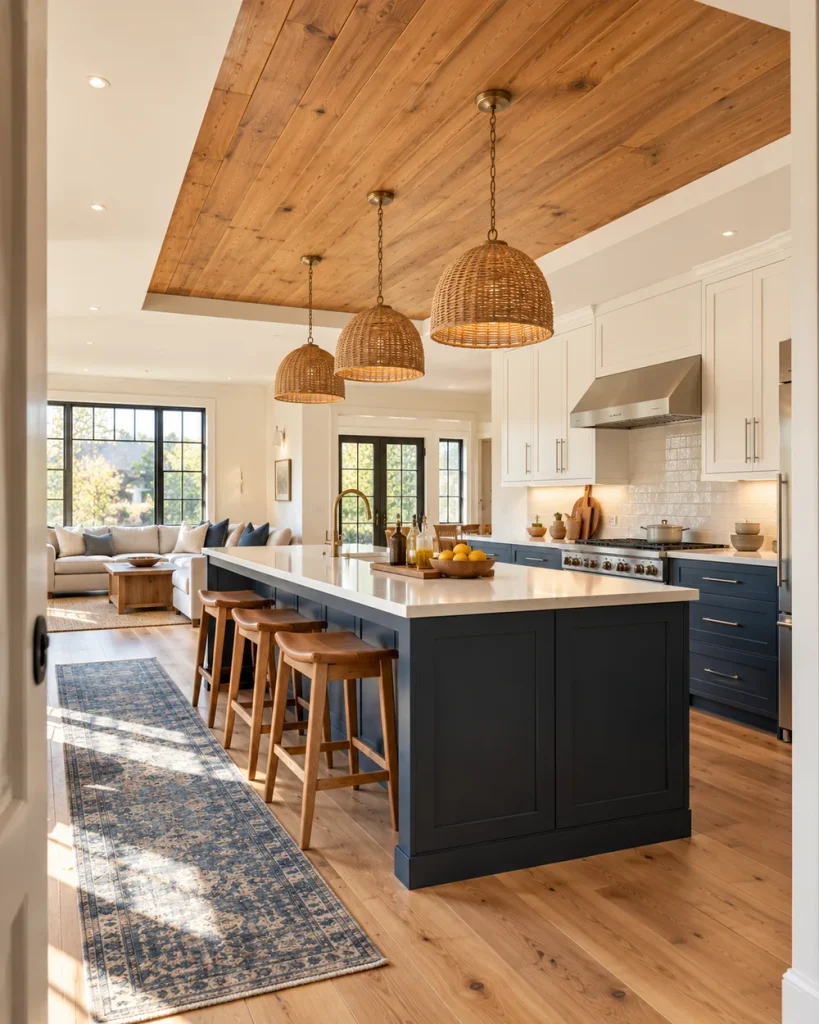
You do not have to wood the whole ceiling. Framing just the zone above the island or dining table in planks turns that spot into a destination, and it costs far less than a full ceiling. This works beautifully in open-plan homes where the kitchen shares one big ceiling with the living room; the wood marks where cooking happens without building a wall.
Keep the wood area slightly larger than the island footprint, about a foot of overhang on each side, so it feels generous rather than cramped. Run the planks perpendicular to the island’s long edge for contrast, and hang pendants from the wood section so the light fixtures feel anchored. Paint the surrounding ceiling its usual white so the wood reads as an intentional feature, not an unfinished job.
Best for: Open-concept kitchens and anyone watching the budget.
Cozy Tip: If your pendants hang from the wood zone, have the electrician add the boxes before the planks go up. Cutting neat holes in finished wood is much harder than planning ahead.
Go Two-Tone: Wood Field, Painted Beams
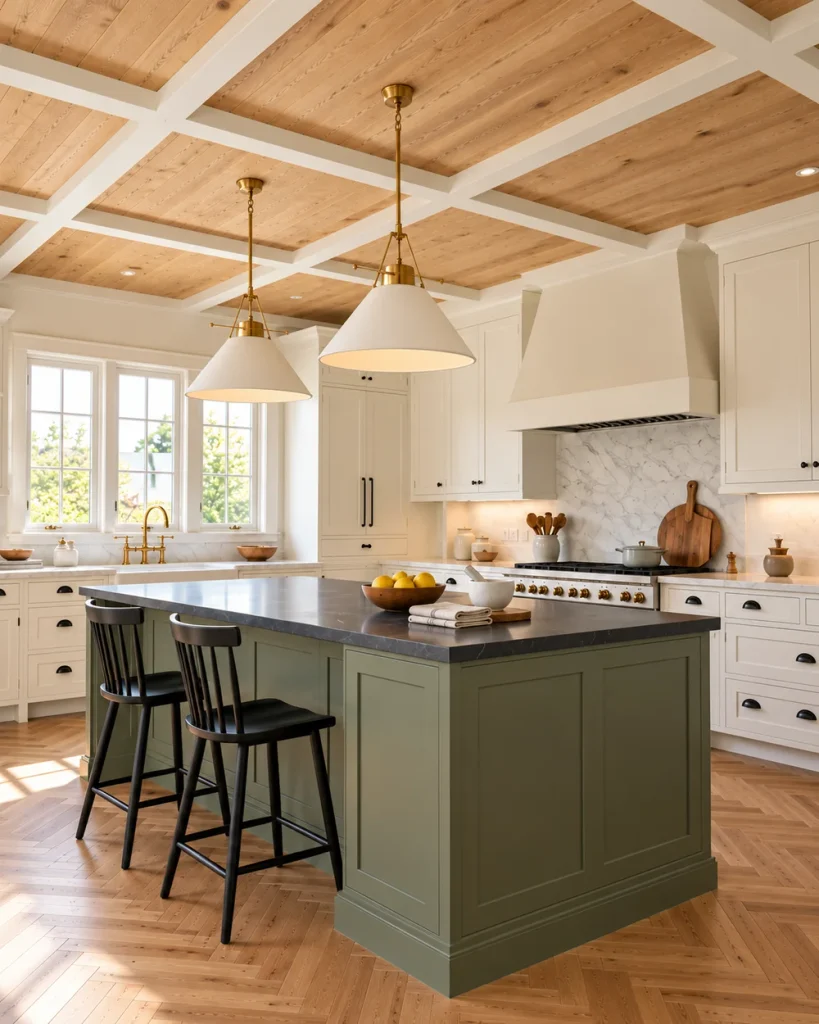
Two-tone ceilings are one of the freshest wood ceiling kitchen ideas because they give you contrast without a second material. Leave the plank field in a natural or stained wood tone and paint the beams to match the trim or cabinets. The beams then act like a frame that organizes the wood, and the whole ceiling feels designed rather than rustic by default.
This pairing solves a common problem: all-wood ceilings can turn a kitchen orange-toned, especially under warm bulbs. White or cream beams cool the palette and tie the ceiling to the rest of the room’s trim. It also lets you be bolder with the plank stain, since the painted beams keep things from going too dark. Keep the beam color identical to your window and door trim so the eye reads it as one system.
Best for: Kitchens where an all-wood ceiling would feel too heavy or too orange.
Cozy Tip: Paint the beams first and the field second. It is far easier to cut a straight line with the plank edge as your guide than to tape crisp lines on installed beams.
Whitewash Pine in a Low-Ceiling Kitchen
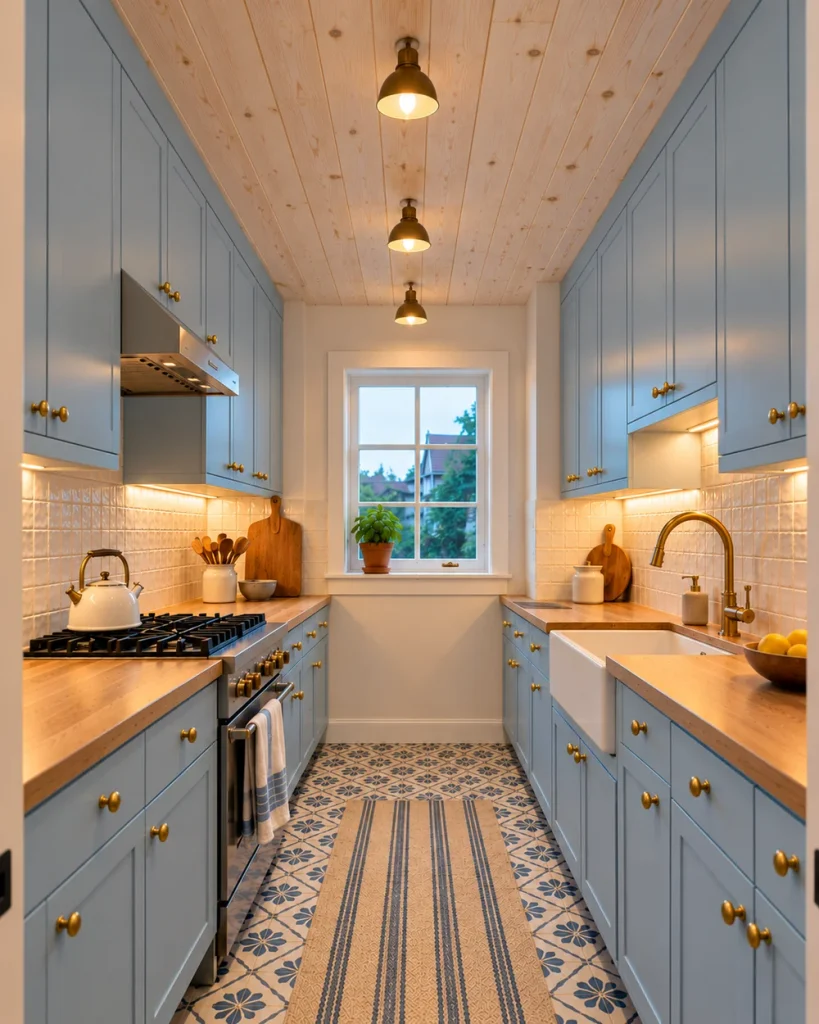
Low ceilings and dark wood are a bad match, but whitewash fixes that. The thinned white finish lets the pine grain show through while reflecting far more light than bare wood, so an 8-foot ceiling feels taller instead of pressing down. In a galley kitchen, where you see the ceiling up close, that soft grain keeps things interesting without stealing light.
Apply the whitewash before installation if you can; brushing boards on sawhorses is faster and cleaner than working overhead. That forgiveness is what makes whitewash one of the easiest wood ceiling kitchen ideas for a first-timer. Two thin coats beat one thick one, because thick whitewash hides the grain you are trying to keep. Seal with a matte water-based polyurethane so the finish stays wipeable near the stove. Water-based finishes also give off fewer fumes, and the EPA’s guide to indoor air and VOCs explains why you should keep windows open while paints and varnishes dry. Pair it with light cabinets and one warm accent, like oak stools or brass hardware, so the room does not go cold.
Best for: Galley kitchens, basement kitchens, and any ceiling under 9 feet.
Cozy Tip: Whitewash darkens slightly as it cures. Judge the final color after 48 hours, not while it is wet, before you commit to the whole ceiling.
Stain It Dark Walnut for a Moody Kitchen
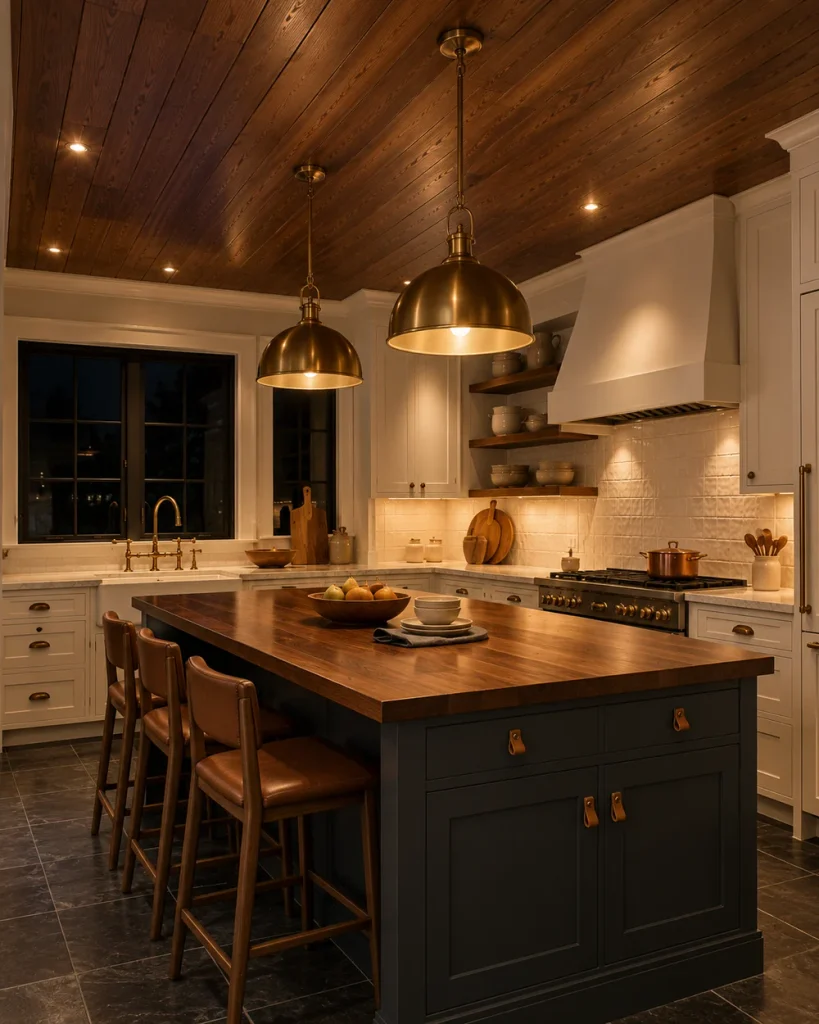
A dark wood ceiling is a commitment, and in the right kitchen it pays off completely. Deep walnut or espresso stain overhead makes white cabinets glow by contrast and turns brass or copper fixtures into jewelry. The room feels intimate in the evening, like a restaurant you never want to leave, which is exactly what a big eat-in kitchen should feel like.
Dark ceilings demand good lighting, so plan for it. Recessed lights on dimmers keep the work zones bright, and warm pendants with 2700K bulbs keep the mood. Without enough light, dark wood goes flat and cave-like. This is also the one finish where professional spraying earns its money; dark stain shows every lap mark and uneven patch, and a sprayed satin topcoat looks a level above brushed-on. Keep walls light to balance the drama.
Best for: Large kitchens with tall ceilings and strong natural or layered lighting.
Cozy Tip: Go one shade lighter than your first instinct. Dark stain always reads deeper on a ceiling than on a sample board held at eye level.
Match the Ceiling to Your Floor
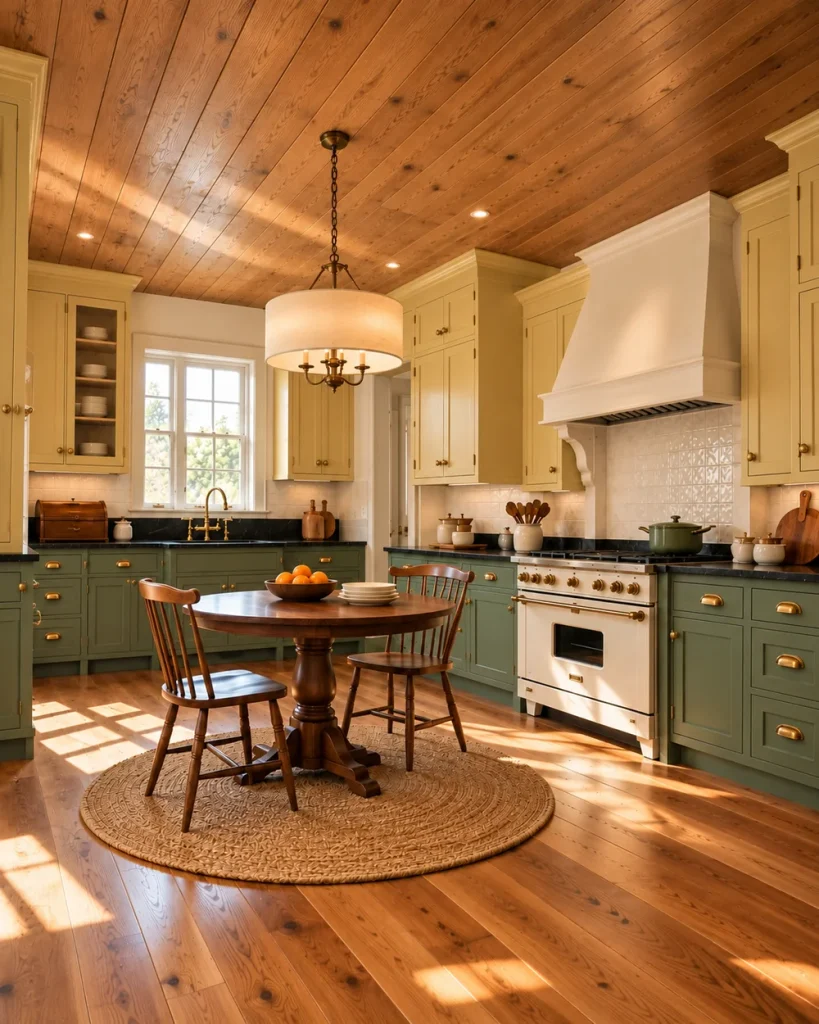
Matching the ceiling stain to the floor is a quiet, designer-level move. When the wood above echoes the wood below, the room feels wrapped and intentional, and the eye travels up instead of stopping at the cabinet line. It works best with medium oak or warm brown tones that already live comfortably in kitchens.
The trick is close, not identical. Floors take abuse and darken over time, so a ceiling stained to match exactly on day one will drift apart within a couple of years. Instead, pick a ceiling stain one step lighter than the floor; it reads as a pair without demanding perfection. This is one of those wood ceiling kitchen ideas that costs nothing extra, since you are choosing a stain either way, but it makes the whole room feel considered.
Best for: Homes with hardwood or wood-look floors where you want a pulled-together feel.
Cozy Tip: Bring a loose floorboard or a photo of the floor in daylight to the paint store. Matching from memory is how ceilings end up clashing with floors.
Inlay a Wood Border Around a Drywall Center
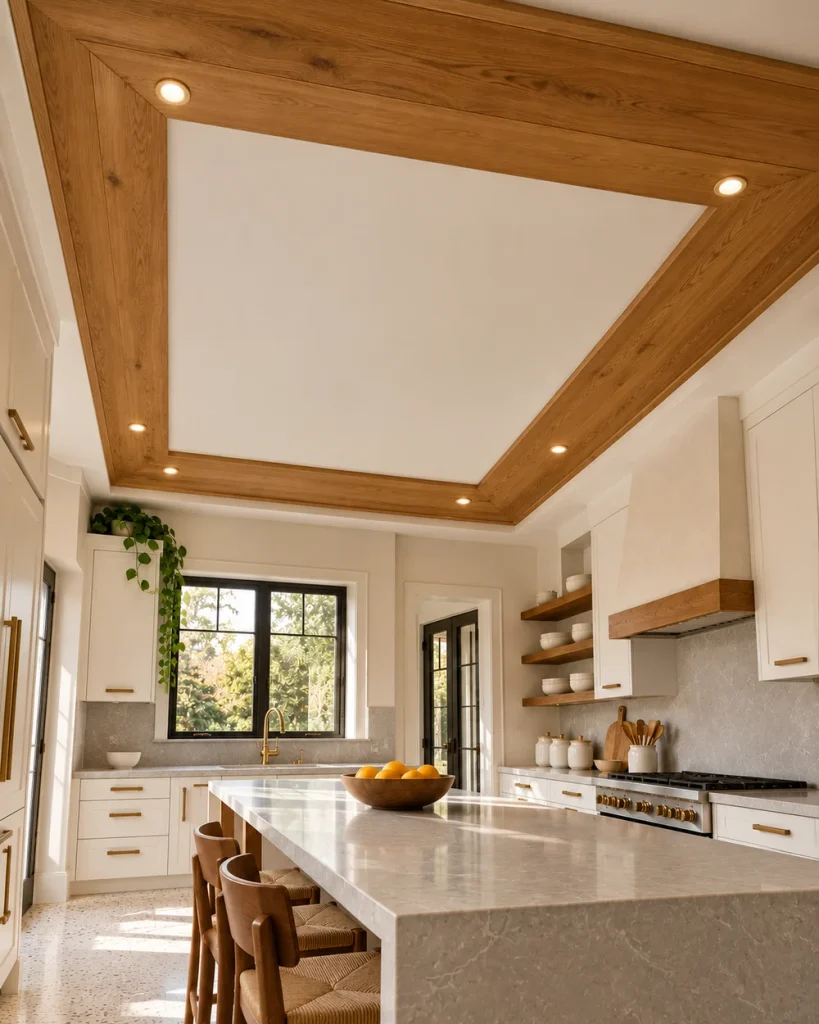
If a full wood ceiling feels like too much, frame the room with it instead. A wood plank border, about two to three feet wide, runs around the edge of the ceiling while the center stays smooth drywall. It reads like a picture frame for the room and gives you wood texture where the eye naturally lands, near the walls and windows.
This approach has practical perks too. The border hides the seam where wall meets ceiling, so you can skip crown molding, and it gives recessed lights a wood surround that looks custom. Keep the border width proportional: in a small kitchen, two feet is plenty; in a large one, go wider so it does not look like an afterthought. Stain the border to echo the floor or island for a tied-together look.
Best for: Anyone who loves wood but wants to keep the ceiling mostly bright.
Cozy Tip: Miter the border corners like a picture frame rather than butting the planks. The 45-degree joints look far more finished from below.
Lay Reclaimed Planks Over the Cook Zone
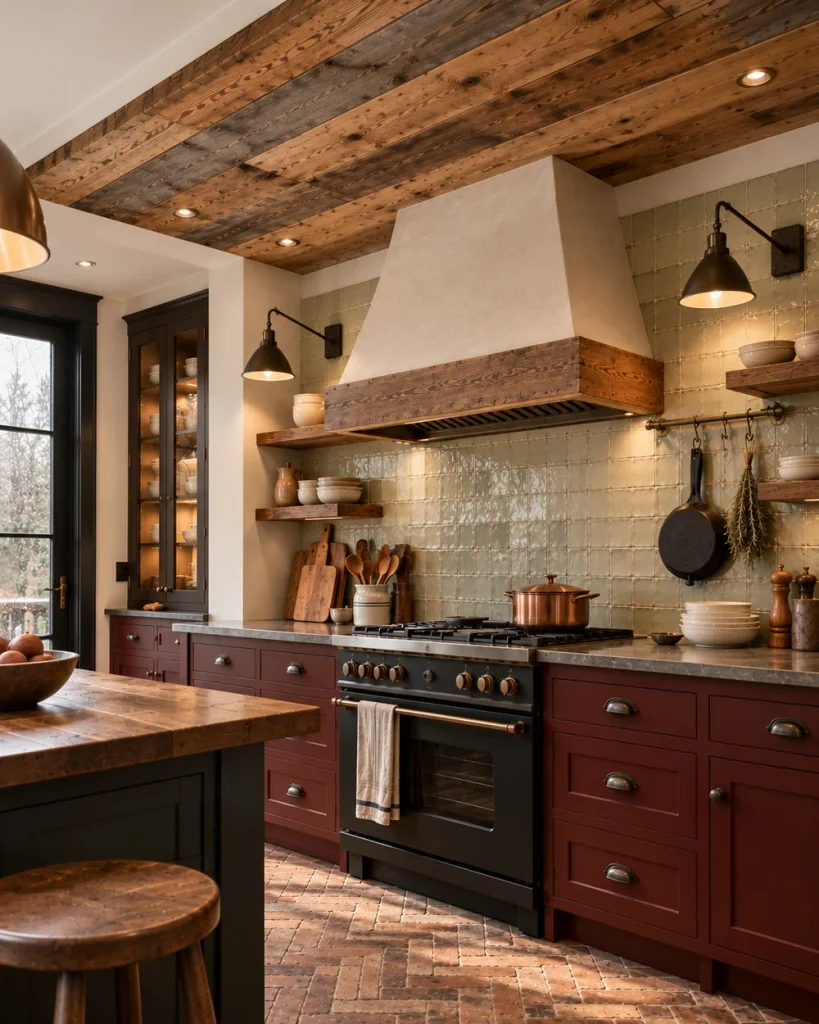
Reclaimed planks carry nail holes, saw marks, and color variation that new wood cannot fake, and concentrating them over the range turns the hardest-working spot in the kitchen into the most characterful. The rough old wood above a smooth plaster hood, trimmed with a band of the same reclaimed planks, is a contrast that always works.
Source carefully. True reclaimed boards need cleaning, denailing, and a check for old finishes, and they should be sealed on all sides before they go up in a kitchen. Buy about 15 percent more than you measure, since old boards have unusable ends. If the budget balks, use reclaimed only in this one zone and new planks elsewhere; nobody will know, because the eye reads the cook zone as the feature. Among these wood ceiling kitchen ideas, this one rewards a little patience at the lumber yard most. Keep the rest of the ceiling simple so the reclaimed section stays the star.
Best for: Farmhouse and industrial kitchens where character matters more than perfection.
Cozy Tip: Ask the supplier what building the wood came from. Boards from the same structure match better in tone, which saves you sorting time on installation day.
Keep It Natural With a Matte Clear Seal
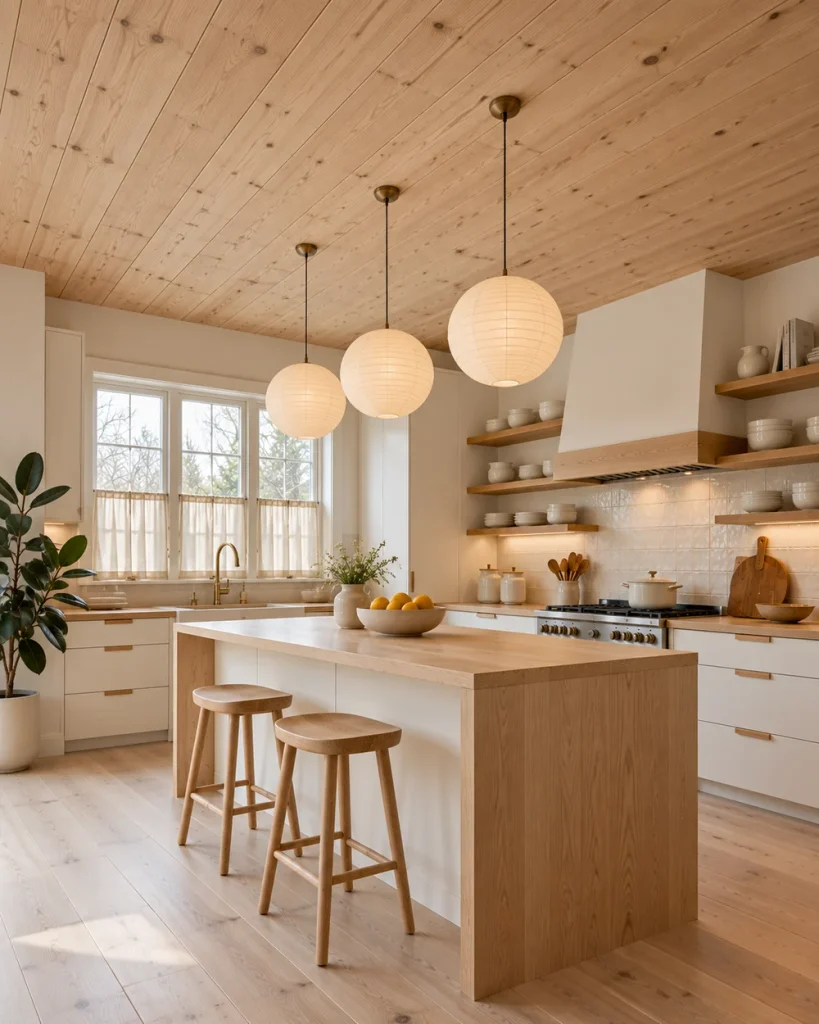
Sometimes the best finish is barely a finish at all. A clear matte sealer on pine or fir protects the wood from kitchen air while changing its color almost not at all, which suits Scandinavian and minimalist kitchens where the wood should feel honest. The grain stays visible, the tone stays pale, and the ceiling quietly warms the room without declaring itself.
Matte matters here. Satin or gloss sealers reflect the under-cabinet and recessed lights as shiny streaks, which cheapens the calm look. A dead-flat matte finish absorbs light evenly and looks like raw wood that somehow never stains. Reapply every few years in a hardworking kitchen; the maintenance is a light scuff and one coat, not a full refinish. Pair with pale cabinets, simple hardware, and one green plant for the full effect.
Best for: Minimalist, Scandinavian, and Japandi kitchens that want warmth without visual noise.
Cozy Tip: Test the sealer on a scrap board next to your cabinets. Some “clear” sealers add a faint amber cast that only shows once it is overhead.
Paint the Ceiling Your Cabinet Color
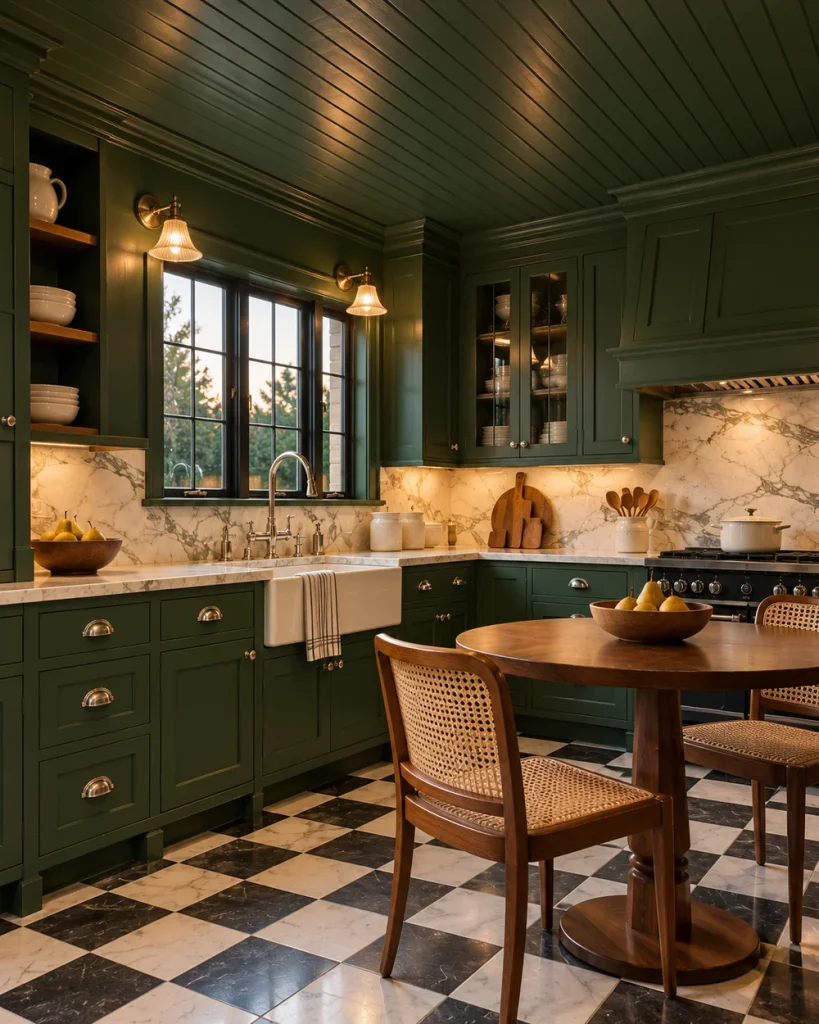
Color-drenching is not just for walls. Painting a plank or beadboard ceiling the same color as your cabinets, deep green, navy, or warm charcoal, wraps the kitchen in one continuous hue and makes the ceiling feel like part of the design instead of leftover space. It is bold, but because it repeats a color already in the room, it feels cohesive rather than random.
This works best when the cabinets are the star and everything else stays quiet: light counters, simple backsplash, minimal hardware. Keep counter styling just as calm, with a few grouped pieces like these fall kitchen countertop decor ideas, so the color overhead has room to breathe. The ceiling then reads as an extension of the cabinetry. Use the exact same paint, not a close match, and the same sheen family so the color behaves identically in different light. In a small kitchen, keep to mid-tone colors rather than near-black so the room does not close in.
Best for: Confident color lovers whose cabinets already carry the room.
Cozy Tip: Paint the ceiling before the walls. Cutting in a dark ceiling color against fresh walls is far easier than protecting finished walls from ceiling splatter.
Mistakes to Avoid With a Wood Kitchen Ceiling
Steer clear of these and your wood ceiling kitchen ideas will age well instead of turning into regrets.
Skipping the Range Hood Upgrade
Wood and grease are a bad combination. If your vent only recirculates, fix that before the planks go up, or the ceiling above the stove will darken and turn sticky within a few years.
Choosing Stain Under Store Lights
Store lighting hides undertones. Test boards in your own kitchen at different times of day, and remember that ceiling stain reads darker once it is overhead.
Ignoring the Lighting Plan
Adding junction boxes after the wood is up means cutting finished boards and patching. Plan every pendant, spotlight and under-beam strip first.
Going Too Dark in a Small Kitchen
Dark wood needs tall ceilings and strong light. In a compact kitchen, whitewash or warm white keeps the room open, and dark wood works best as a small accent.
Forgetting Expansion Gaps
Wood moves with humidity, and kitchens are humid rooms. Leave the gaps the manufacturer specifies at the walls and hide them with trim, or boards will buckle.
Frequently Asked Questions About Wood Kitchen Ceilings
What is the cheapest way to get a wood look on a kitchen ceiling?
Faux polyurethane beams are the cheapest convincing option; a few beams over an island cost far less than real timber and install in a day. Painting existing drywall with a wood-grain technique is cheaper still but rarely fools anyone up close. For real wood on a budget, tongue-and-groove pine installed yourself is the sweet spot.
Is a wood ceiling hard to maintain in a kitchen?
Not if it is sealed and vented. A satin or matte polyurethane topcoat lets you wipe the ceiling with a damp cloth, and a properly vented range hood keeps most grease out of the air before it settles. Raw or oil-finished wood near a stove will darken and spot over time, so always seal within a few feet of the cook zone.
Can I do a wood ceiling in a kitchen with low ceilings?
Yes, with light finishes. Whitewash or warm white paint keeps an 8-foot ceiling feeling tall, and slim faux beams add character without stealing headroom. Skip dark stains and deep coffers in low rooms; they visually press the ceiling down.
Will a dark wood ceiling make my kitchen feel smaller?
It can, which is why dark wood belongs in larger kitchens with tall ceilings and layered lighting. Recessed lights on dimmers plus warm pendants keep a walnut or espresso ceiling dramatic instead of gloomy. In a small kitchen, use dark wood as an accent, like the island zone only, rather than wall to wall. That is why several of these wood ceiling kitchen ideas treat dark stain as a feature, not a full coverage.
Do I need a professional to install a wood ceiling?
Not always. Faux beams and paint or whitewash are solid DIY projects. A full tongue-and-groove ceiling is a moderate weekend job for two people with a nail gun and a miter saw. Hire a carpenter for vaulted ceilings, custom coffers, or anything involving rewiring, since mistakes overhead are expensive to fix.
Final Thoughts
A wood ceiling is one of those changes you notice every single day without getting tired of it. It warms the morning coffee routine and makes dinner feel a little more special, and unlike most renovations, you do not need to gut the room to get there. Pick the tone that talks to your cabinets, be honest about your budget and ceiling height, and start with the ideas above that fit real life, not a showroom. These wood ceiling kitchen ideas are meant to be lived with, and the best one is the version that makes your kitchen feel more like yours. Pin the wood ceiling kitchen ideas you love and compare them side by side before you buy a single board.